
Slime Finder: Find Slime Chunks in Minecraft Fast
Are you tired of manually finding slime chunks? You have been mining for hours. You need slimeballs. Maybe it is for sticky pistons, slime blocks, or just to finally finish that redstone build you started three weeks ago. But slimes are nowhere. You wander through swamps at night. Nothing.
This is one of the most common problems in Minecraft, and it happens because slimes do not spawn randomly across the world. They only show up in very specific places called slime chunks, and without knowing where those chunks are, you can search forever.
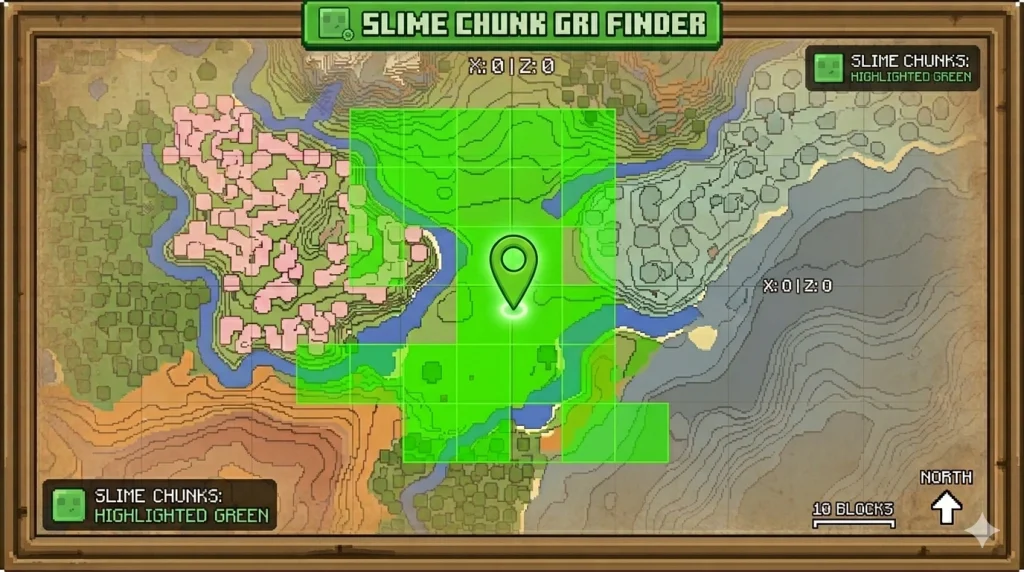
Our Minecraft Seed Map tool solves this issue in seconds. Enter your world seed, select your game version, and the slime chunk finder marks every eligible chunk on the map. No need to wander anymore.
How to Use the Slime Finder Tool
Using the slime finder takes less than a minute. Here is how to do it.
Find Your World Seed
Open Minecraft and type /seed in the chat. Your world seed is the long number that appears. Copy it. In single-player, this always works. On a multiplayer server, you need operator permissions, so ask your server admin if you cannot run the command yourself.
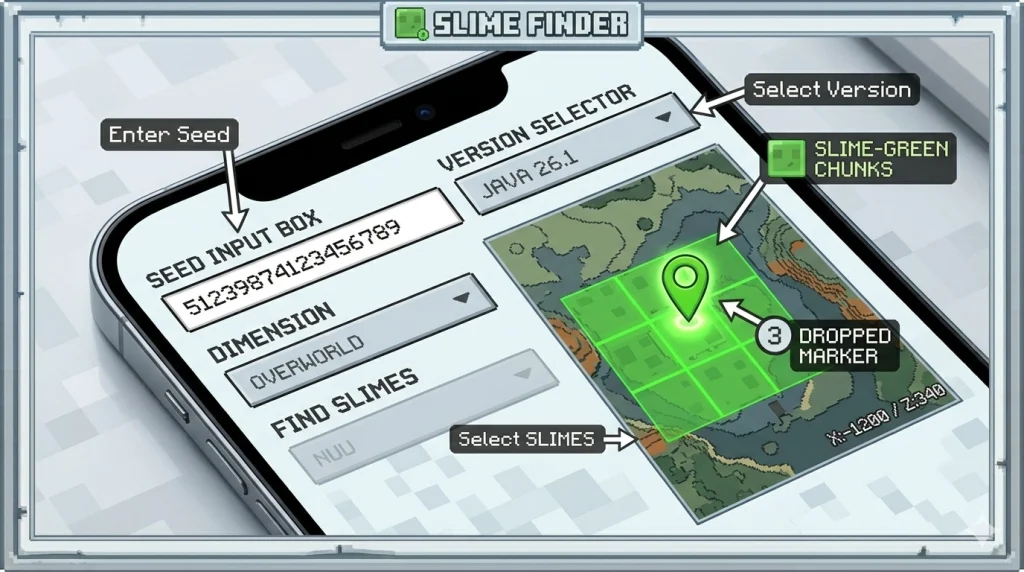
Enter the Seed and Pick Your Version
Open the slime chunk finder. Paste your seed into the seed field. Make sure there are no extra spaces before or after the number, because even one space can break the result. Then select your edition (Java or Bedrock) and the correct Minecraft version.
Read the Map and Go
The map shows slime chunks highlighted. Navigate to one near your base. Note the X and Z coordinates. Head to those coordinates in your world, then mine down below Y=40. A large flat clearing at Y=11 gives you the best surface area for slimes to spawn on.
Right-click on the map to drop a custom marker so you remember exactly which chunk you are targeting. You can also use the village finder and dungeon finder while you are at it to plan other spots nearby.
Where Do Slimes Spawn in Minecraft?
Slimes spawn in two entirely different locations. Understanding both is important because they work very differently.
Slime Chunks Underground
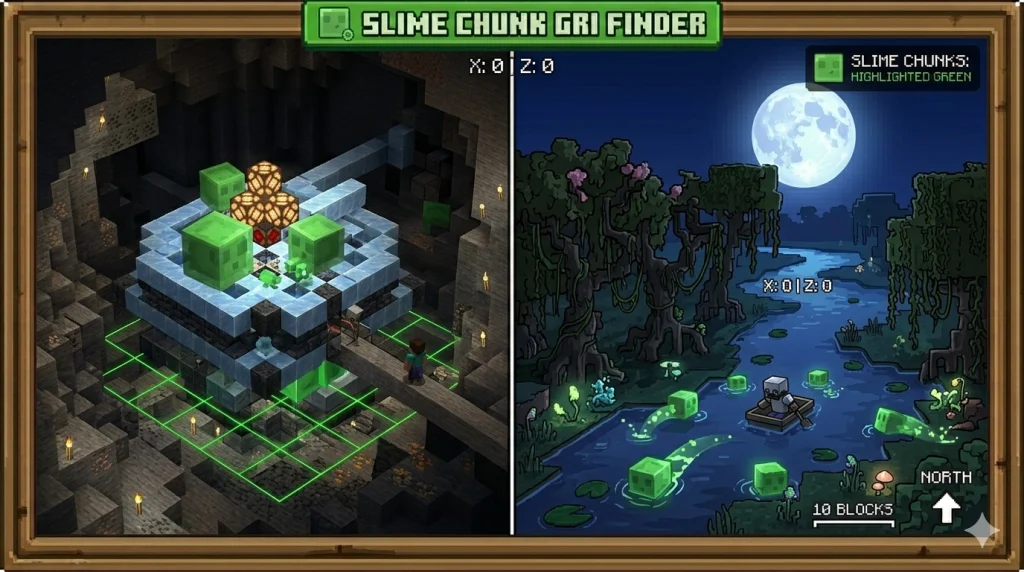
Slimes spawn naturally in slime chunks below Y=40 in the Overworld. Light level, time of day or weather does not matter here. If you are standing inside a verified slime chunk and you go below Y=40, slimes can spawn.
In Java Edition, slime chunks are tied to your world seed. Two different worlds with two different seeds will have slime chunks in entirely different locations. This is exactly why the Minecraft Seed Map tool exists. You plug in your seed, and it tells you where your slime chunks are.
In Bedrock Edition, the chunk coordinates are fixed for every world. Every single Bedrock world shares the same slime chunk locations. You can still use the slime finder for this. Just select Bedrock Edition, and it shows you the fixed chunk map without needing a seed.
Slimes in slime chunks spawn in groups of four in Java Edition. In Bedrock, they spawn individually. Either way, once you find the right chunk and clear space below Y=40, they will come.
Swamps and Mangrove Swamps
The second place slimes spawn is in swamp and mangrove swamp biomes, and this method works on the surface. No mining required. Slimes spawn here between Y=51 and Y=69 when the light level is 7 or lower.
The catch is the moon phase. Slimes spawn most often during a full moon and not at all during a new moon. The brighter the moon, the higher the spawn chance. On a full moon, the numbers are noticeably higher, so timing your swamp visits around moon cycles makes a real difference.
This is a solid option if you need a few slimeballs quickly and do not want to set up a full underground farm. Head to a swamp on a full moon, keep the area dark, and slimes will start showing up.
You can use our biome finder to locate swamps and mangrove swamps near your base before you go exploring.
What Do Slimes Drop?
Slimeballs are the whole reason most players go looking for slimes in the first place. Small slimes drop between 0 and 2 slimeballs per kill. With a Looting III sword, you can push that up to 5 slimeballs per small slime.
Frogs are a special case. When a frog eats a small slime, it drops exactly 1 slimeball every time, with no variation and no looting bonus.
On the experience side, killing a single large slime and all the smaller slimes it splits into can yield up to 28 XP total. That makes slime chunks a decent passive XP source if you set up an AFK farm.
Slimeballs are used in crafting sticky pistons, slime blocks, magma cream, leads, and more. If you do any serious redstone work or building, having a steady slime supply is genuinely useful in the long term.
Check out the ancient city finder and bastion remnant finder if you are also gearing up for harder content alongside your slime farm setup.
Best Seeds for Finding Slimes
Some seeds are just better for slime farming because they place multiple slime chunks close together or near easy-to-reach areas. Here are a few standout Java Edition seeds worth trying in 2026.
Seed | Nearby Slime Chunks | Notes |
2980543205524870072 | Several clusters near spawn | Dense grouping, good for early-game farming |
12345 | Standard distribution | Classic test seed, predictable layout |
-9065479248748140 | Multiple adjacent chunks | Great for building multi-chunk slime farms |
8767654321098765 | Near desert biome | Easy overground access to the swamp nearby |
404 | Close spawn chunks | Old favorite, still works on modern versions |
Use any of these with the slime finder to see the exact chunk layout before you start digging. Enter the seed, confirm the slime chunks near spawn, and build your farm right on top.
Java Edition vs Bedrock Edition: Key Differences
This comes up constantly, and it matters for how you use the finder.
Feature | Java Edition | Bedrock Edition |
Slime Chunk Locations | Based on a specific world seed | Same for every single world |
Seed Requirement | Must enter the seed for accuracy | Not needed for chunk finding |
Swamp Mechanics | Follows the moon and light levels | Follows the moon and light levels |
Spawning Style | Slimes spawn in groups | Slimes spawn one by one |
Farm Efficiency | High yield per spawn cycle | Lower yield per spawn cycle |
If you play on a server with different generation settings or an older world that was updated from an earlier version, always use the stronghold finder and nether fortress finder alongside the slime chunk finder to plan your whole base layout efficiently.
What Is a Slime Chunk Finder?
A slime chunk finder is a tool that reads your world seed and uses the same algorithm Minecraft uses to calculate which chunks can spawn slimes underground. It then shows you exactly where those chunks are present on a live map of your world.
About 1 in 10 chunks in any Minecraft world are slime chunks. But they do not appear randomly. In Java Edition, the algorithm combines your world seed with the chunk coordinates to decide whether each chunk qualifies. That means every world has a unique pattern. In Bedrock Edition, the pattern is the same across all worlds because the algorithm does not use the world seed.
Once you know which chunks are slime chunks, you dig down below Y=40 inside one of them and wait. Slimes will spawn there regardless of light level, time of day, or weather.
This is the fastest and easiest way to find slimes in Minecraft.
Other Finders Worth Using
The slime chunk finder is one piece of a much bigger toolkit. While you are planning your world, use the biome finder to locate the best farming biomes, the village finder to find early loot and trading.
For late-game planning, the endcity finder helps you navigate the End dimension efficiently. For complete seed analysis before you even start a world, the Minecraft Seed Map gives you everything at once. Check slime chunks, biomes, structures and more from a single view.
Frequently Asked Questions
Where do slimes spawn in Minecraft?
Slimes spawn in two locations. Underground, they spawn below Y=40 inside slime chunks, which are specific chunks that make up roughly 1 in 10 of all Minecraft chunks. On the surface, they spawn in swamp and mangrove swamp biomes between Y=51 and Y=69 when the light level is 7 or lower.
What is the difference between a slime and a slime chunk?
A slime is the mob itself, the green bouncing cube that attacks players. A slime chunk is a type of underground chunk where slimes are able to spawn below Y=40.
How do I find slime chunks without a seed?
In Bedrock Edition, you do not need a seed at all. In Java Edition, the seed is required because slime chunks are unique to each world.
What is the best Y level for slimes underground?
Y=11 is the most widely recommended level. It sits comfortably below the Y=40 ceiling for slime spawning and stays above the main bedrock layer. Flattening out a large area at Y=11 inside a confirmed slime chunk gives you the maximum possible spawn surface.
Do slimes spawn during the day in swamps?
They can technically spawn during the day if the light level in the area is 7 or lower. In practice, swamp slime spawning almost always happens at night. Full moon nights give the highest spawn chance, so night visits during full moons are the most productive.
Does the slime finder work for both Java and Bedrock?
Yes. For Java Edition, enter your world seed from the /seed command. For Bedrock Edition, the seed is optional because the slime chunk layout is identical across all Bedrock worlds.